
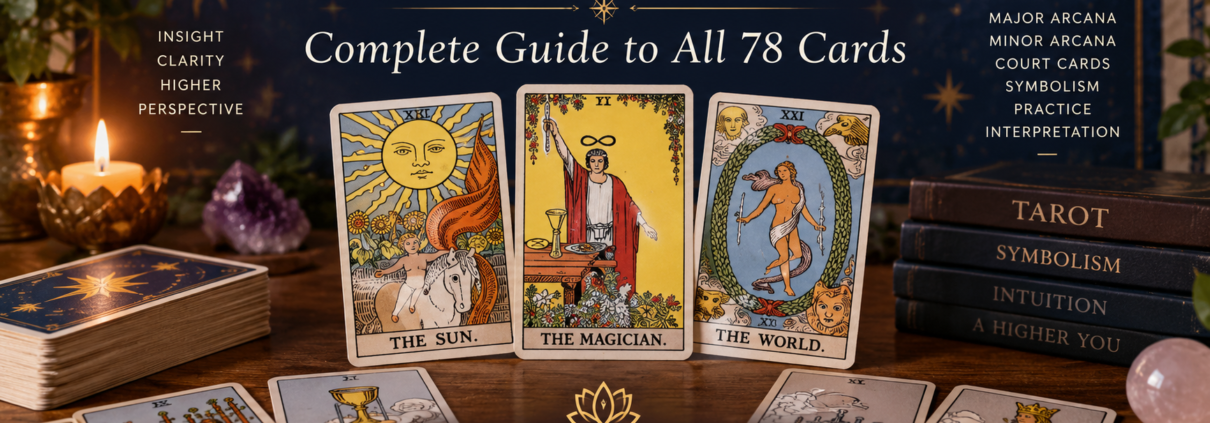
Rider Waite Tarot Card Meanings: Complete Guide to All 78 Cards
Direct Answer: Rider Waite Tarot is a 78-card Tarot system consisting of 22 Major Arcana cards and 56 Minor Arcana cards. Each card combines imagery, symbolism and traditional meanings that are interpreted according to the question, card position and surrounding cards in a spread. This guide explains the Rider Waite Tarot card meanings, symbolism and practical interpretation of all 78 cards.
This guide by Dr. Vivek G Goel, Founder of UrDivineFriend and Professional Tarot Coach & Reader, is designed to help learners understand Rider Waite Tarot in a structured and practical way.
Rider Waite Tarot card meanings combine symbols, numbers, colors, elements, figures and intuition. A strong reader learns both the textbook meaning and the context of the question.
Rider Waite Structure
How the Rider Waite Tarot Deck Is Structured
The Rider Waite Tarot deck is divided into the Major Arcana and Minor Arcana. The Major Arcana contains 22 cards representing broader life themes and significant experiences, while the Minor Arcana contains 56 cards covering everyday situations, emotions, challenges and actions.
Major Arcana and Minor Arcana in Rider Waite Tarot
The Major Arcana and Minor Arcana play different roles in Rider Waite Tarot. The 22 Major Arcana cards generally represent significant life themes, lessons and turning points, while the 56 Minor Arcana cards relate more closely to everyday situations, emotions, actions, relationships and practical experiences. Together, they form the complete 78-card Rider Waite Tarot deck.
The Rider Waite Tarot deck is divided into two main groups: the Major Arcana and the Minor Arcana. Understanding this distinction is one of the first steps in learning how Tarot cards work together in a reading.
Major Arcana
The Major Arcana contains 22 cards, beginning with The Fool and continuing through The World. These cards generally represent major life themes, turning points, personal development, important lessons and deeper psychological or spiritual experiences.
When several Major Arcana cards appear in a spread, the reading may indicate that the situation carries greater significance or involves an important stage of personal development.
Minor Arcana
The Minor Arcana contains 56 cards divided into four suits: Wands, Cups, Swords and Pentacles. These cards are generally associated with everyday experiences, emotions, communication, actions, relationships, work and practical matters.
Each suit contains numbered cards from Ace to Ten along with four Court Cards: Page, Knight, Queen and King.
The 22 Major Arcana Cards in Rider Waite Tarot
The Major Arcana consists of 22 cards numbered from 0 to 21. Together, these cards represent important themes, experiences, lessons and stages of personal development. The Fool is numbered 0 and begins the traditional Major Arcana sequence.
- 0 – The Fool — beginnings, openness and taking a new step
- I – The Magician — skill, initiative and using available resources
- II – The High Priestess — intuition, inner knowledge and observation
- III – The Empress — growth, nurturing and abundance
- IV – The Emperor — structure, authority and stability
- V – The Hierophant — learning, tradition and guidance
- VI – The Lovers — relationships, alignment and important choices
- VII – The Chariot — direction, determination and focused action
- VIII – Strength — courage, patience and inner control
- IX – The Hermit — reflection, wisdom and inner guidance
- X – Wheel of Fortune — change, cycles and shifting circumstances
- XI – Justice — balance, accountability and fair decisions
- XII – The Hanged Man — pause, perspective and seeing differently
- XIII – Death — endings, transition and transformation
- XIV – Temperance — balance, moderation and integration
- XV – The Devil — attachment, temptation and restrictive patterns
- XVI – The Tower — disruption, revelation and sudden change
- XVII – The Star — hope, renewal and inspiration
- XVIII – The Moon — uncertainty, intuition and hidden influences
- XIX – The Sun — clarity, vitality and positive expression
- XX – Judgement — evaluation, awakening and important realization
- XXI – The World — completion, integration and accomplishment
The Four Suits of the Minor Arcana
The 56 Minor Arcana cards are divided into four suits: Wands, Cups, Swords and Pentacles. Each suit contains 14 cards — Ace through Ten plus Page, Knight, Queen and King. The suits help a reader understand which area of life is receiving the strongest emphasis in a Tarot spread.
Wands
Wands are commonly associated with action, motivation, creativity, ambition, confidence and personal drive. In a reading, Wands can highlight what a person wants to start, pursue, develop or achieve.
Cups
Cups are commonly associated with emotions, relationships, feelings, connection, intuition and emotional fulfilment. They frequently appear in questions involving love, family, friendships and emotional wellbeing.
Swords
Swords are commonly associated with thoughts, communication, decisions, conflict, challenges and mental activity. They can show how a person is thinking about a situation and where clarity or difficult decisions may be required.
Pentacles
Pentacles are commonly associated with work, money, resources, stability, health and practical matters. In a reading, they can relate to career, business, finances, property and the practical steps needed to create stability.
How Court Cards Work in Rider Waite Tarot
Direct Answer: The 16 Court Cards in Rider Waite Tarot are the Page, Knight, Queen and King of each of the four suits: Wands, Cups, Swords and Pentacles. Court Cards can represent people, personality traits, attitudes, roles or ways of approaching a situation, depending on the question and surrounding cards in the spread.
Pages
Pages often relate to learning, curiosity, messages, new ideas and the early stage of development. They can indicate someone who is exploring or beginning to understand the energy of a suit.
Knights
Knights usually represent movement, pursuit, action and the way energy is expressed. Each Knight shows a different style of moving toward a goal, challenge or experience.
Queens
Queens often represent maturity, understanding, receptivity and an internal mastery of the suit’s qualities. They can describe how a person manages or expresses that energy from within.
Kings
Kings commonly represent leadership, authority, responsibility and an outward command of the suit’s qualities. They can indicate a person who has developed greater control or experience in that area.
In a Tarot reading, Court Cards should not automatically be treated as specific people. Their meaning depends on the question, surrounding cards, position in the spread and the overall context of the reading.
How to Read Symbols in Rider Waite Tarot Cards
Rider Waite Tarot cards use detailed visual symbolism to add meaning beyond basic card keywords. When interpreting a card, observe the people, objects, colors, landscape, direction of movement, numbers and overall mood of the image.
Look at the Main Image
Begin with the most noticeable figure or object on the card. Ask what is happening in the scene, what action is taking place and what emotion or situation the image appears to represent.
Observe Colors
Colors can add another layer of interpretation. Instead of reading a color in isolation, consider how strongly it appears in the card and how it supports the overall imagery and message.
Notice Numbers
Numbers can help reveal patterns and stages of development within the Tarot. Cards with the same number across different suits may share a broader theme while expressing it through different areas of life.
Study Direction and Movement
Notice where figures are looking or moving. A figure facing another card, turning away from it or moving toward something can provide useful context when interpreting cards together in a spread.
Read the Card in Context
A symbol should not automatically have one fixed meaning. Its interpretation depends on the question, the position of the card in the spread, surrounding cards and the overall situation being explored.
Practical Tip: First describe what you can actually see in the card before trying to interpret it. This helps develop observation skills and reduces dependence on memorized keywords.
How Rider Waite Card Meanings Change in a Tarot Spread
A Tarot card does not always have exactly the same meaning in every reading. Its interpretation can change depending on the question, its position in the spread, the surrounding cards and the overall pattern created by the reading.
To understand how Tarot is applied in an actual consultation, explore our guide to professional Tarot reading, including the types of questions and situations a Tarot reading can help clarify.
Consider the Question
Start by connecting the card to the question being asked. The same card may highlight different aspects of a relationship, career, financial or personal-development question.
Understand the Card Position
The position assigned to a card gives it context. For example, a card placed in a challenge position should be interpreted differently from the same card appearing as guidance, an opportunity or a possible outcome.
Read Cards Together
Individual card meanings become more useful when cards are interpreted in relation to one another. Look for repeated themes, similar symbols, numbers, suits and patterns across the spread rather than reading every card separately.
Notice Major and Minor Arcana Balance
A spread containing several Major Arcana cards may point toward broader or more significant themes, while a spread dominated by Minor Arcana may focus more strongly on everyday circumstances, choices, emotions and actions.
Look for Repeating Suits
Several cards from the same suit can show where the reading is concentrated. Multiple Cups may emphasize emotional or relationship matters, while several Pentacles may draw attention toward practical, financial or work-related concerns.
Practical Tip: Interpret the spread as one connected story rather than a collection of unrelated card definitions. This helps create a clearer and more practical Tarot reading.
How to Learn Rider Waite Tarot Step by Step
Learning Rider Waite Tarot becomes easier when you follow a structured process instead of trying to memorize all 78 cards at once. Begin with the basic structure of the deck, develop observation skills and gradually move toward practical readings.
- Understand the deck structure: Learn the difference between Major Arcana, Minor Arcana, the four suits and Court Cards.
- Study the card imagery: Observe the people, objects, colors, numbers, symbols and actions shown on each card.
- Understand the core meaning: Learn the central theme of each card rather than memorizing long lists of keywords.
- Connect the card to the question: Practice interpreting the same card in different contexts such as relationships, career, money and personal decisions.
- Practice card combinations: Start with two or three cards and observe how their meanings interact before moving to larger spreads.
- Learn structured spreads: Understand what each position represents and interpret cards according to their role within the spread.
- Practice complete readings: Bring the cards together into one clear, connected and practical interpretation instead of giving separate meanings for every card.
Learning Principle: A professional Tarot reader develops through understanding, observation and consistent practice — not by memorizing 78 fixed definitions.
If you are building your Tarot foundation, you may also read our guide on how to learn Tarot online for a structured learning approach.
Once you are comfortable with card meanings, symbolism and spreads, the next stage is developing practical reading and consultation skills. Read our guide on how to become a professional Tarot reader to understand the broader learning and practice journey.
Common Mistakes When Learning Rider Waite Tarot
Learning Tarot is not only about knowing card meanings. Avoiding common interpretation mistakes can help beginners develop clearer and more consistent reading skills.
Memorizing Without Understanding
Trying to memorize fixed meanings for all 78 cards can make readings mechanical. Learn the core theme of a card, but also observe its imagery, symbolism and context.
Reading Every Card Separately
A Tarot spread should be interpreted as a connected message. Consider how cards relate to one another instead of giving an isolated definition for each card.
Ignoring the Question
The same card can communicate different aspects of a situation depending on what is being asked. Always interpret the card in relation to the actual question.
Giving Too Much Importance to One Card
One card should not automatically determine the entire reading. Consider its position, surrounding cards and the overall pattern of the spread before reaching a conclusion.
Treating Tarot as Fixed Prediction
Tarot can be used to explore possibilities, guidance and patterns rather than treating every card as a guarantee that a particular event must happen.
Practical Tip: Aim for clarity and context rather than trying to make a reading sound complicated. A useful interpretation should help the person understand the situation and possible next steps.
How to Practice Rider Waite Tarot
Regular practice helps turn knowledge of individual Tarot cards into practical reading skills. Instead of immediately attempting large spreads, begin with simple exercises that develop observation, interpretation and confidence.
Start With One Card
Choose one card and describe what you see before checking its traditional meaning. Notice the figures, objects, symbols, colors, numbers and overall mood of the card.
Ask One Clear Question
Practice with a specific question rather than drawing cards without context. A clear question makes it easier to understand how the meaning of a card changes according to the situation.
Practice With Two or Three Cards
Once individual cards become familiar, use two-card or three-card combinations. Focus on how the cards interact and what connected message they create.
Keep a Tarot Journal
Record the question, cards drawn, your initial interpretation and what you learned from the reading. Reviewing previous readings can help you identify patterns and improve your interpretation skills over time.
Practice Different Types of Questions
Use practice questions related to relationships, career, money, decisions and personal development. This helps you understand how the same card can be interpreted differently depending on context.
Review the Complete Reading
Before finishing, summarize the reading in a few clear sentences. This develops the ability to move from individual card meanings to one practical and understandable interpretation.
Practice Principle: The goal is not to remember more meanings every day. The goal is to become better at observing, connecting and interpreting the cards in context.
How to Frame Better Questions for Rider Waite Tarot
The quality of a Tarot reading often improves when the question is clear, focused and connected to a real situation. Instead of asking overly broad questions, frame the reading around one specific area that needs clarity.
Avoid Very Broad Questions
Questions such as “What will happen in my life?” are too open-ended. A focused question gives the cards a clearer context and makes interpretation more practical.
Focus on One Situation at a Time
If a person has concerns about relationship, career and money, it is usually better to explore each area separately rather than combining everything into one question.
Ask for Clarity, Guidance or Possibility
Questions can be framed around what is possible, what needs attention, what may help improve the situation or what factors should be considered before making a decision.
Use Time Carefully
When asking about timing, define the period clearly where possible. A question about the next three months provides a more specific reading context than asking only “When will this happen?”
Avoid Questions That Remove Personal Responsibility
Tarot can support reflection and decision-making, but it should not replace personal judgment. Questions are usually more useful when they explore choices, influences and possible next steps.
Practical Tip: Before drawing cards, rewrite the question in one clear sentence. If the question is easy to understand, the reading is usually easier to interpret as well.
Using the PGT Framework in a Tarot Reading
At UrDivineFriend, Tarot readings can be structured using the PGT framework — Possibility, Guidance and Time. This approach helps organize a reading into clear areas instead of giving disconnected card meanings.
P — Possibility
First explore the possibility surrounding the question. The cards can help identify the present situation, influencing factors and what may be possible based on the current circumstances.
G — Guidance
Next focus on guidance. Consider what actions, changes, precautions or areas of attention may help the person approach the situation more effectively.
T — Time
Where appropriate, the reading can then explore time within a clearly defined period. Timing should be interpreted in context rather than presented as an absolute guarantee that an event must occur on a fixed date.
Example: Instead of asking only “Will I get a new job?”, a structured reading can explore the possibility of a job change, guidance on what may improve the opportunity and the relevant time period to examine.
PGT Principle: Possibility explains what may happen, Guidance explores what can be done, and Time provides a defined period for examining how the situation may develop.
Using HRCM to Identify the Area of a Tarot Question
Before interpreting Tarot cards, it is useful to identify the main area of the question. At UrDivineFriend, questions can be organized using the HRCM framework — Health, Relationship, Career and Money. This gives the reading a clear context before the cards are interpreted.
H — Health
Health-related questions can be explored for general reflection, emotional patterns and supportive guidance. Tarot should not be used as a substitute for medical diagnosis, treatment or advice from a qualified healthcare professional.
R — Relationship
Relationship questions may involve love, marriage, compatibility, communication, emotional concerns or the direction of a relationship. Identifying the exact concern helps make the reading more focused.
C — Career
Career questions can include jobs, professional growth, business decisions, opportunities, workplace situations and career changes. The question should clearly define what aspect of career needs guidance.
M — Money
Money-related readings may explore financial patterns, opportunities, decisions or areas that require greater attention. Tarot can provide reflective guidance but should not replace professional financial advice.
How HRCM and PGT Work Together: HRCM identifies what area the question belongs to, while PGT helps structure what the reading explores — Possibility, Guidance and Time.
Example: A question about changing jobs falls under Career in HRCM. The reading can then use PGT to explore the possibility of change, guidance for improving the situation and an appropriate time period to examine.
How HRCM and PGT Work Together in a Tarot Reading
A structured Tarot reading can begin by identifying the problem area through HRCM and then exploring that question through PGT. This creates a simple reading process that moves from identifying the concern to providing focused interpretation.
- Step 1 — Identify the area: Use HRCM to determine whether the primary concern relates to Health, Relationship, Career or Money.
- Step 2 — Define the exact question: Narrow the concern into one clear question instead of combining several problems in the same reading.
- Step 3 — Check Possibility: Explore what appears possible based on the present situation and the cards drawn.
- Step 4 — Give Guidance: Interpret what actions, changes, precautions or areas of attention may help the person move forward.
- Step 5 — Explore Time: Where appropriate, examine the situation within a clearly defined time period without presenting timing as an absolute guarantee.
- Step 6 — Summarize Clearly: Bring the reading together into a concise explanation covering the possibility, practical guidance and relevant time context.
UrDivineFriend Reading Structure: HRCM identifies the area of concern. PGT structures the answer. Together they help move a Tarot reading from individual card meanings toward a clearer and more organized consultation.
Example of HRCM and PGT in a Rider Waite Tarot Reading
Consider a person asking: “I am currently working but thinking about changing my job. Should I look for a new opportunity?”
Step 1 — Identify the Area with HRCM
The primary concern is professional growth and job change, so the question falls under C — Career.
Step 2 — Frame the Question Clearly
Instead of asking only “Should I change my job?”, the reading can be structured around a clearer question: “What should I understand about the possibility of changing my job and finding a better professional opportunity?”
Step 3 — P: Explore the Possibility
The cards are first interpreted to understand the current situation, factors supporting or restricting change and what possibilities may be developing around a new professional opportunity.
Step 4 — G: Explore the Guidance
The next part of the reading focuses on practical guidance. The cards may highlight areas such as preparation, skill development, communication, patience, networking or a change in approach depending on the cards drawn.
Step 5 — T: Examine Time
Where appropriate, the reading can examine a defined period — for example, the next three months — rather than making an unrestricted prediction about exactly when an event must happen.
Step 6 — Give One Clear Summary
The final interpretation should connect the cards into one understandable answer covering the possibility, relevant guidance and time context instead of presenting several unrelated card meanings.
Key Principle: The cards provide the interpretation, while HRCM and PGT provide a structure for asking and answering the question clearly.
Simple 3-Card PGT Tarot Spread
The PGT framework can also be used as a simple three-card Rider Waite spread. After identifying and clearly framing the question, draw one card for each part of PGT.
Card 1 — Possibility
This card explores the possibility surrounding the question based on the present situation. Consider the opportunities, challenges and influences shown by the card.
Card 2 — Guidance
This card focuses on what may help the person move forward. Interpret it as guidance, an area requiring attention, a possible action or a change in approach.
Card 3 — Time
This card is interpreted within a clearly defined time period relevant to the question. Rather than treating it as a guaranteed date, use it to explore how the situation may develop within the selected timeframe.
Example layout: Possibility → Guidance → Time
After interpreting the three positions individually, connect them into one clear answer. The objective is not to give three separate card meanings, but to explain what appears possible, what guidance may be useful and how the situation may develop within the defined period.
Important: The PGT spread is a structured interpretation method used by UrDivineFriend for educational and guidance purposes. Tarot reflects possibilities and guidance rather than guaranteeing a fixed future outcome.
When to Use the PGT Tarot Spread
The PGT Tarot Spread is useful when a person has one clearly defined question and wants the reading organized around three areas: what appears possible, what guidance may help and what time period is relevant to the situation.
Career and Job Questions
PGT can be used for questions about job opportunities, career changes, professional growth or business decisions by exploring the possibility, practical guidance and a defined time period.
Relationship Questions
For relationship concerns, the spread can explore the possibility surrounding the situation, guidance for handling it and how the situation may develop within a selected timeframe.
Money and Business Questions
PGT can help organize questions about financial opportunities or business situations. Tarot should be used for reflective guidance and should not replace professional financial advice.
Decision-Making Questions
When someone is uncertain about a decision, PGT can help separate the reading into what appears possible, what factors or actions deserve attention and what may develop during the period being examined.
When Not to Use PGT
PGT works best with one focused question. If several unrelated concerns are combined into the same reading, separate them into individual questions first. Tarot should also not replace qualified medical, legal, financial or other professional advice where such expertise is required.
Simple rule: First identify the area with HRCM, then frame one clear question, and use PGT to explore Possibility, Guidance and Time.
Daily Rider Waite Tarot Practice for Beginners
You do not need to practice for hours every day to improve your Tarot reading skills. A short and consistent Rider Waite practice routine can help develop observation, interpretation and confidence.
Step 1 — Draw One Card
Select one Rider Waite card and spend a few moments observing the image before looking at any reference material.
Step 2 — Write What You See
Note the people, objects, colors, numbers, symbols, expressions and movement visible in the card. Begin with observation rather than interpretation.
Step 3 — Identify the Core Message
Write one or two sentences describing what you believe is the central theme of the card. Keep the interpretation simple instead of trying to remember every possible meaning.
Step 4 — Apply the Card to HRCM
Consider how the same card might be interpreted differently in Health, Relationship, Career and Money contexts. This develops flexibility instead of dependence on one fixed meaning.
Step 5 — Practice PGT
Choose a clear practice question and consider how the card could contribute to Possibility, Guidance or Time depending on its position in a reading.
Step 6 — Record Your Learning
Keep your observations and interpretations in a Tarot journal. Reviewing them regularly can help you recognize patterns and see how your understanding develops with practice.
Daily Practice Principle: Focus on understanding one card deeply rather than trying to memorize many cards quickly. Consistency and contextual interpretation are more useful than memorization alone.
From Learning Rider Waite Cards to Giving a Complete Tarot Reading
Knowing the meanings of Rider Waite cards is only one part of becoming a confident Tarot reader. A complete reading also requires clear question framing, contextual interpretation, communication skills and the ability to bring multiple cards together into one understandable answer.
Understand the Client’s Question
Before drawing cards, identify what the person actually wants clarity about. Separate multiple concerns where necessary and convert the main concern into one focused question.
Choose an Appropriate Spread
Select a spread according to the question rather than using the same layout for every situation. A simple question may require only a few cards, while a more detailed situation may need a structured spread with clearly defined positions.
Interpret the Cards in Context
Connect each card with the question, its position and the surrounding cards. Avoid giving memorized definitions that do not relate directly to the situation being explored.
Connect the Reading Into One Story
After interpreting individual cards, identify the overall pattern. Look for repeated suits, Major Arcana influence, supporting or contrasting cards and the central message emerging from the spread.
Communicate the Answer Clearly
A useful reading should be understandable to the person receiving it. Explain the interpretation in simple language and distinguish observations, possibilities and guidance instead of overwhelming the client with Tarot terminology.
Maintain Professional Boundaries
Tarot can support reflection and decision-making, but a reader should avoid presenting interpretations as guaranteed outcomes or replacing qualified medical, legal, financial or other professional advice.
Professional Reading Principle: The objective is not to demonstrate how many card meanings you know. It is to turn the cards into a clear, contextual and responsible interpretation that helps the person understand the situation.
Frequently Asked Questions About Rider Waite Tarot
How many cards are in the Rider Waite Tarot deck?
The Rider Waite Tarot deck contains 78 cards: 22 Major Arcana and 56 Minor Arcana. The Minor Arcana is divided into Wands, Cups, Swords and Pentacles.
Is Rider Waite Tarot good for beginners?
Yes. The Rider Waite Tarot deck is widely used for learning because its illustrated scenes provide visual clues that can help beginners understand symbolism, situations and card meanings.
Do I need to memorize all 78 Tarot card meanings?
No. Memorizing keywords can provide a starting point, but effective Tarot reading also involves understanding the imagery, symbolism, question context, card position and relationship between cards in a spread.
What is the difference between Major Arcana and Minor Arcana?
The 22 Major Arcana generally represent broader life themes and significant experiences. The 56 Minor Arcana generally relate to everyday situations, emotions, thoughts, actions and practical matters.
How long does it take to learn Rider Waite Tarot?
There is no fixed time required to learn Rider Waite Tarot. Progress depends on the learner’s study method, observation skills, practice and experience interpreting cards in different situations.
Can one Tarot card have different meanings?
Yes. A card’s interpretation can change according to the question, its position in the spread, surrounding cards and the overall context of the reading.
About This Rider Waite Tarot Guide
This Rider Waite Tarot guide is created by Dr. Vivek G Goel, Founder of UrDivineFriend and Professional Tarot Coach & Reader. His approach to Tarot education focuses on structured learning, practical interpretation, clear question framing and helping learners move beyond memorizing fixed card meanings.
Through UrDivineFriend, he teaches aspiring Tarot readers how to understand cards in context, interpret spreads and develop a clear and responsible approach to professional Tarot reading.
Learn more about Dr. Vivek G Goel and his professional background.
Want to move from understanding Tarot cards to structured practical learning? Explore Tarot courses by UrDivineFriend for guided training, practical reading techniques and professional Tarot development.